
Do something extraordinary with your income this year.
A Tech Leader's Guide to Donating Employer Stock for Greater Impact
It's an impressive milestone, and likely a complex one. You probably have a lot on your mind heading into it: estate planning, exercise and tax strategy, and a position that's about to be a significant portion of your net worth. It's exciting, overwhelming and probably life-changing, all at once.
Some decisions can wait, like what to do with the proceeds, your portfolio strategy, and how to approach your next chapter. With others, it's better to make them before selling your shares. Charitable giving is one of these. One of the biggest opportunities to affect taxes and giving closes when you sell. And you don't need to know your charitable strategy right away to start using it.
There's a big difference between shares donated before a sale and the proceeds donated afterward. Both the dollar value and the tax treatment can change significantly.
After you donate shares to a Donor Advised Fund (DAF), you can recommend investing them in a wide range of opportunities, such as angel deals, established VCs, and private credit funds for underestimated founders and entrepreneurs.
ImpactAssets is one of the most active and experienced impact investors out there. We have 15+ years of experience handling $5B+ in assets and 1,700+ portfolio companies and funds, giving us access to investments most donors can't reach on their own.
The window closes when you sell.
The earlier we talk, the more time you have to decide.
By the time an IPO or sale is on the horizon, you've probably already heard the case for gifting your vested equity. Maybe that insight came from a trusted advisor, a peer who's been through it, or your own research. The mechanics are simple: Give the shares, not the proceeds. When you donate exercised stock you've held for more than a year, you never pay capital gains tax on its growth. The pre-tax value goes to your charitable work. You can generally claim a deduction for the full fair market value, within annual income limits. If you sell first and then donate, the gain is taxed before you give, so you're donating what's left and deducting less.
Let's say you've held $1M in shares for more than a year, with a minimal cost basis. If you gift them before selling, the full $1M lands in your DAF, and your deduction is based on the full $1M.* If you were to sell first, the gain would be taxed before you give. You'd pay roughly $371,000 in taxes,* leaving about $629,000 for your charitable purpose. You'd get a $629,000 deduction instead of $1M. Same shares, same intent, but $371,000 goes to taxes instead of to the work you care about.
SELLING FIRST

GIFTING BEFORE SELLING

What that conversation often stops short of is the other half of the decision. You want to know about the tax savings, but you're also concerned with what the capital goes on to do. A Donor Advised Fund (DAF) can help. It's a charitable account you fund now and grant from over time. It puts more of what you've built behind the next generation of innovative and world-changing ideas.
If you've been a founder, early employee, or investor in a company that IPOs or sells, you've already spent the resource you can't get back: time. You've put years or even your entire career behind a big idea about the future: open access to information, faster medical breakthroughs, artificial intelligence that benefits humanity, or the human exploration of space. A sale or IPO could turn that work and risk into wealth, maybe more than you've ever had.
Funding a DAF lets you put that same instinct behind more than one big idea. Your time went into a single company. The capital it created can back a whole slate of them.
An ImpactAssets DAF is built to be invested, not just granted out. It comes with ImpactAssets Capital Partners: an experienced investment team, vetted pipeline, and institutional-grade diligence. It's designed to put your capital to work across private-market impact investments in areas like climate, health, and financial inclusion.
We steward more than $5B and are consistently ranked among the most active venture investors in the country. Because we pool capital from across our client base, we can often access funds at minimums well below what you'd be quoted on your own.
In practice, that might mean:
- PAYING IT FORWARD: Funding the kind of early, unproven bet someone once made on you.
- DOUBLING DOWN: Backing a bet too risky for your own balance sheet, the kind charitable capital can carry when personal capital can't.
- GOING LONG: Backing a complex technology on a longer horizon than a traditional fund could stomach, so something the world needs gets the time it takes to develop.
If you'd rather source your own deals, we can serve as your back office. You bring the deal, our team reviews it for your DAF, and if it's approved, our investment operations team handles execution and ongoing administration. We've done it more than 1,300 times across check sizes, structures, sectors, and asset classes.
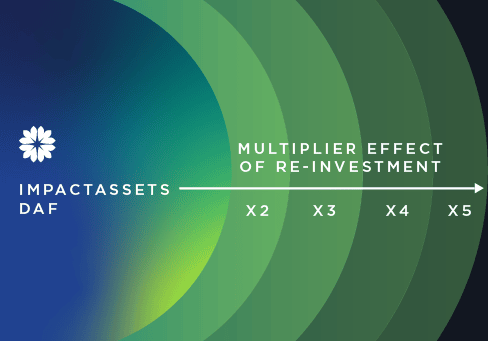
And because investment returns flow back into your DAF, a single contribution can keep working for years, funding one bet and then the next.
CONTRIBUTE*
Give your vested equity before selling. No capital gains tax, and a deduction at full fair market value.
INVEST
Your balance goes to work in liquid and semi-liquid impact strategies or private-market impact investments.
RE-INVEST
Investment gains flow into your DAF for reinvestment and future granting.
GRANT
Recommend grants to the organizations you want to support, on your timeline.
*Contributions are irrevocable and charitable. Returns stay in your DAF, where they can be reinvested or granted. Deductions for gifts of stock assume shares held more than a year and are subject to annual income limits.
THE FIRST
STEP
Talk to our team. We'll work through your timeline, your equity, and what you want this capital to do next.
Who are your clients?
They're more than 2,000 angel investors, entrepreneurs, family offices, and foundations. They're people who tend to think like investors and want their charitable capital to do the same.
Can I give shares before my company is public?
Often, yes. We accept privately held stock (founder shares, LLC and LP interests, and other pre-liquidity positions). The earlier in the process we start talking, the more room there is to work with. Two things determine what's possible. The gift has to be complete before a sale is effectively locked in, which can happen before anything is signed, and private shares need a qualified independent appraisal to establish the deduction. Your company's terms matter too: transfer restrictions, rights of first refusal, and board approval. That's why the first conversation is usually about your cap table and your timeline rather than paperwork.
How early should I start if I plan to donate shares before an IPO?
As early as you can. The gift has to be complete before a sale is effectively locked in, which can happen before anything is signed. Private shares need a qualified independent appraisal, and transfer approvals from your company can take time. Starting months ahead rather than weeks leaves room for all of it.
Can I donate shares that are under an IPO lockup?
Sometimes. Every agreement is different, but many lockup agreements allow gifts to charity as long as the recipient agrees to the same lockup terms. Your company's counsel can confirm what your agreement allows, and we can work through the terms with you.
Can I donate stock options or RSUs?
Usually not directly. Unvested RSUs and most stock options can't be transferred, so the usual path is to donate the shares once they've vested or been exercised. Each type of equity is taxed differently, so check the details with your tax advisor before you give.
Do I get the deduction when I donate private shares, or when the DAF sells them?
You receive the deduction when you make the gift. For shares you've held more than a year, it's generally their fair market value on the date the gift is complete. A qualified independent appraisal establishes the amount for private shares. What the DAF later sells them for doesn't change it.
What types of investments can I make, and are there restrictions?
The range is wide, and it includes investments in for-profit companies and funds, not only grants to nonprofits. What makes them impact investments is the intent behind them: capital deployed to generate measurable social or environmental benefit alongside a financial return. ImpactAssets adds no restrictions beyond the ones that apply to any DAF, and every investment you recommend goes through our review. Because the assets are irrevocably charitable, the investments and any returns they produce stay within your fund and can't flow back to you personally. Where a proposed investment touches a company you're involved with, we'll work through it with you. Those situations come up often and get a closer compliance review, since DAF rules bar benefits to donors and the people close to them.
What happens to any positive returns from these investments?
They flow back into your fund, where you can either recycle them into new investments or grant them out, compounding your impact over time. Because DAF assets are irrevocably charitable, returns stay in the fund and keep adding to what you can give.
Why a DAF rather than a foundation?
Mostly because it's simpler and less expensive to run. A private foundation carries setup costs, staffing, excise taxes, an annual payout requirement, and a public 990 filing that puts your giving on the record. A DAF lets you recommend where the money goes and how it's invested, including impact investments, with far less operational burden and without the public disclosure. And it doesn't have to be one or the other. Plenty of family offices and foundations run a DAF along with their existing structures as a dedicated carve-out for impact investing specifically.
Do you also offer investment advisory on assets outside of the DAF?
Yes. ImpactAssets Capital Partners, our SEC-registered investment adviser, works with clients on impact investing well beyond the DAF. So, if your goals extend past your fund, that's a conversation we can have.



What the “One Big Beautiful Bill Act” Means for 2026 Charitable Giving
…and why the ImpactAssets Donor Advised Fund can help before year end.

4 Reasons to Open an ImpactAssets Donor Advised Fund Before Year-End
Act now. Build your strategy over time.